

FEI International Conference: Data Literacy and the Role of AI in Education

Marie Dresse Degiorgi
5 minutes read |


On July 1, two members of the LMDDC team, Pierre de La Celle and Jimmy Fischer, visited the former Sèvres crystal factory as part of the France Éducation Internationale (FEI) International Meeting. This year, the event focused on the theme “Data Literacy in the Age of Generative AI: A Catalyst for Understanding and Dialogue in Education Systems.” It brought together more than 80 key stakeholders from various European countries, including the United Kingdom, Spain, Luxembourg, Estonia, and France. The event, featuring a lively program of conferences, presentations, and workshops led by speakers from both policy-making and technical backgrounds, was both enriching and dynamic.
Why Was LMDDC Involved?
LMDDC is a research center established by Luxembourg’s Ministries of Education and Research, together with the Luxembourg Institute of Science and Technology. Its mission is to support and enable the digital transition of the education sector by providing innovative tools, educational content, and guidance on best digital practices. In addition to its own projects, LMDDC regularly takes part in collaborative projects with other international partners as well as in European initiatives. Given its expertise in EdTech, LMDDC’s presence at this event was therefore of great interest to both its members and the audience, who responded enthusiastically to the two projects presented by Pierre de La Celle and Jimmy Fischer.
What did LMDDC Showcase?
Pierre de La Celle began by presenting skilltech.tools, a tool -or rather, a toolkit- that truly conveys the LMDDC’s philosophy. Designed for all teachers and trainers, this 100% sovereign digital suite offers ready-to-use, open-source, privacy-respecting, and adaptable solutions. With its 13 software applications, skilltech.tools meets the educational needs of organizations and individuals alike, for example with a software for distance learning (Big Blue Button), a collaborative whiteboard tool (Draw), a software for sharing large files (Send), and [Al]lice: a tool that allows teachers to create their own sovereign chatbot based on their lessons. These tools, as varied as they are useful, are free and require no download, as they are all hosted and maintained on LMDDC’s servers in Luxembourg. This device thus reflects a deep conviction: education is a common good that should depend neither on foreign powers nor on the economic interests of multinational corporations.
Jimmy Fischer then presented Polyphonia, a web app designed to overcome the limitations of traditional qualitative surveys. Thanks to AI, it is now possible to avoid biases related to the way questions are phrased (which may be misunderstood or whose answer options may not align with respondents’ experiences). In practice, this offers an alternative to closed-ended multiple-choice questions in a multilingual context. The AI analyzes respondents’ answers -who are asked to write their responses in a free-text field rather than select a satisfaction level on a scale- in terms of content, vocabulary, and punctuation. It then generates a summary in real time and in the language chosen by the moderator-overcoming the limitations of the qualitative approach in terms of data processing time-and analyzes the subtext to highlight the group’s attitudes, concerns, and sensitive issues. This allows the discussion to continue based on what participants have actually expressed, without ever encountering a language barrier.

What Did We Learn?
Mr. Henri de Rohan-Csermak, director of FEI, framed the discussions and reflections around a central question: “Under what conditions can data become a resource for all stakeholders in education, rather than a tool reserved solely for specialists?” The aim was to explore, in a comparative and reflective manner, the various approaches implemented across Europe regarding the collection of operational data in school systems. The day was rich in learning opportunities, but certain insights stood out in particular.
Discussions have been initiated regarding the limits of open source in terms of ethics and intellectual independence. Mr. Abdel Rahamane Baba-Moussa, secretary general of CONFEMEN, made a strong impression on his audience by pointing out that AI, designed to speed up human work, risks having the opposite effect if left unsupervised. He summarized this idea in a brilliant, untranslatable formula « Nous avons inventé les voitures pour aller plus vite, mais aujourd'hui, à Paris, en vélo, on dépasse les autos. » (https://www.youtube.com/watch?v=Fqwi8Gb0Lfg)
This idea aligns with one of the FEI’s objectives, as the organization is committed to ensuring that the education sector does not become a playground for experimentation with AI without safeguards. Indeed, the issues surrounding data management in connection with the implementation of AI systems in schools extend beyond the educational context.
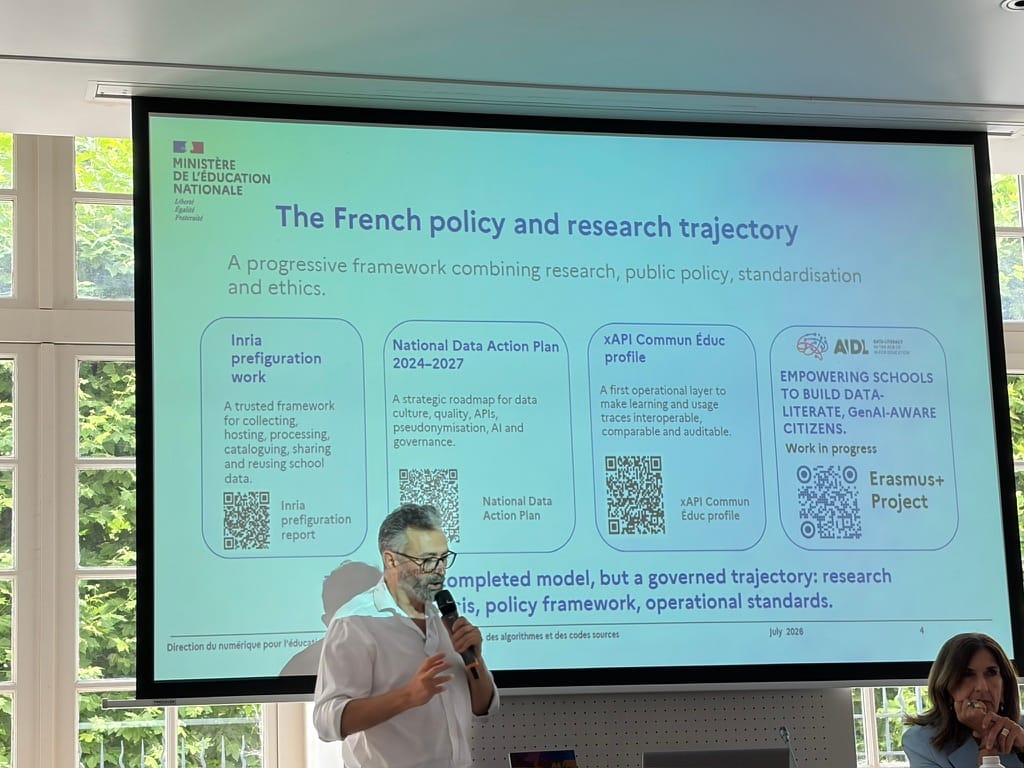
That being said, the discussions revealed that there is still little in-depth pedagogical reflection on AI. Such reflection is largely limited to the question of whether AI helps teachers and students, while pedagogical issues, learning methods, and changes in teaching practices remain relatively unexplored. Lastly, the experts agreed on the need to involve parents in the transition to an AI-driven education system. The goal is not to replace them with AI, but to involve them in helping their children become familiar with these new tools and understand the data-related risks they carry.
We would like to extend our heartfelt thanks to Ms. Sandrine Grégoire and the entire team at the FEI and IIPE-UNESCO for their invitation and for organizing this event, which was as challenging as it was interesting.
If you’d also like to learn more about the tools developed by the LMDDC, please feel free to visit our booths at our offices: 4 Rue Samuel Beckett, 4371 Belvaux (Belval)!
What Is FEI's International Conference?
This meeting, co-organized by the International Institute for Educational Planning (IIEP-UNESCO) and the Ministry of National Education, gathered professionals from various European countries. They highlighted the specific features of the approaches adopted in their respective countries regarding data management and AI in education. Indeed, although the majority of the countries represented are facing similar trends and are bound by the recommendations of the European Commission regarding Education in addition to compliance with the AI Act and the GDPR, education remains primarily a national responsibility. First, experts presented their research and findings, which you can find here. The overall impression that emerged was this: we are producing and collecting more and more data, without necessarily knowing how to manage and use it in an effective and ethical manner.
FEI, a French Institution Focused on Europe and Future
France Éducation International is an institution dedicated to fostering Education and the French language. Founded in 1945, it is an agency of the Ministries of National Education and Higher Education, Research, and Space. Its missions align with the French government’s policy on international cooperation. In addition to its activities promoting and facilitating access to education, FEI supports information sharing and debate at the international level. It draws on a network of more than 1,000 experts and partners and is a member of Sorbonne Universities since 2014.

Marie Dresse Degiorgi