

Meet [AI]lice: the open-source chatbot built for the education sector

Nathan Lenas
5 minutes read |
![Share Meet [AI]lice: the open-source chatbot built for the education sector on LinkedIn](/assets/img/icon_linkedin.svg?v=c621d14e8a)
![Meet [AI]lice: the open-source chatbot built for the education sector](/content/images/size/w1140/2026/06/Screenshot_20260612_160238.png)
We're releasing Alice under the AGPL licence, a tool that lets educators build AI chatbots grounded in their own teaching materials, free for any institution to run, adapt, and build on. If you're based in Luxembourg, you don't even need to self-host: we run a free instance for educators on skilltech.tools.
Bringing AI into a classroom means trusting a tool with your course content and your students' interactions, often without a clear answer to who controls that content or where it ends up.
Alice answers that directly. Because the code is fully open-source, you or your IT team can audit exactly how your content and your students' data are handled and you can run the whole project on your own infrastructure.
Where it started
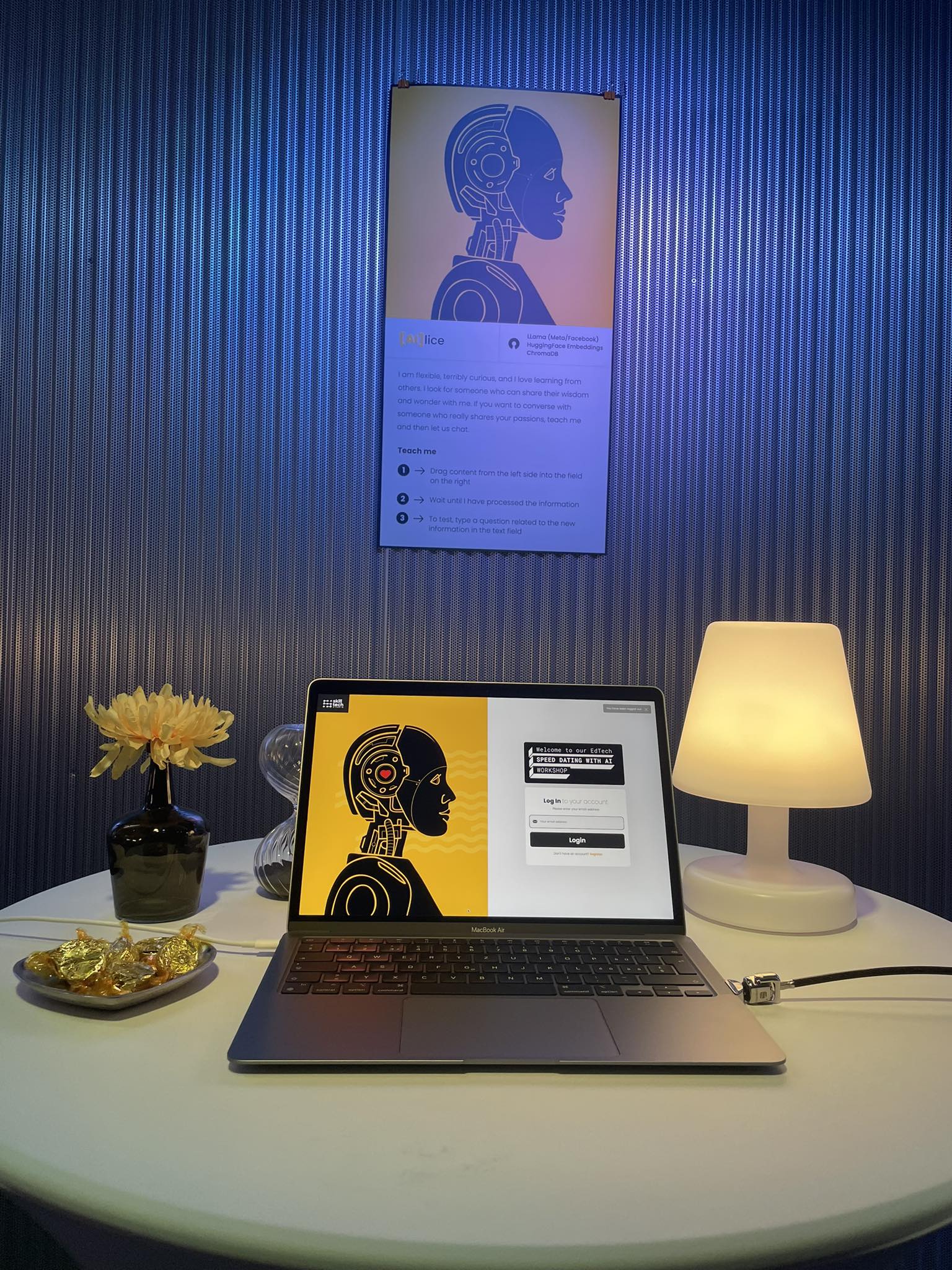
In October 2023, LMDDC hosted EdTech Speed Dating With AI a workshop designed to bring educators and emerging tools together in one afternoon. As part of the event, we showed a rough first version of the idea: a Retrievial Augmented Generation application built on PrivateGPT, running a Llama 3 model, that could answer questions grounded in uploaded course documents. It was early days for the technology, but the demo made one thing obvious: when grounded in the right materials, this approach had good potential for education.
The opportunity to turn that into something real came through ECHT, an Interreg North-West Europe project co-funded by the EU, focused on enabling chemical traceability in the textile industry. LMDDC was brought in to develop the project's knowledge platform and its e-Learning modules a system that needed to give industry professionals reliable, grounded answers from a specific body of technical and regulatory material. Alice was built to power it.
Over the following year it became clear that the original prototype had served its purpose but had reached its limits. Rather than patching around , we rewrote the project from scratch in late 2024, giving us the freedom to build the architecture Alice actually needed. The first early development version of that rewrite was released on 19 December 2024.
A year later, the new version made its public release at EdTech Speed Dating With AI: Reloaded on 4 December 2025, where we published it on skilltech.tools.
Date | Milestone |
October 2023 | First demo at EdTech Speed Dating With AI |
December 2024 | Full rewrite from scratch |
December 2025 | Public launch at EdTech Speed Dating With AI: Reloaded |
June 2026 | Open-source release under GNU AGPL v3 |
What [AI]lice does
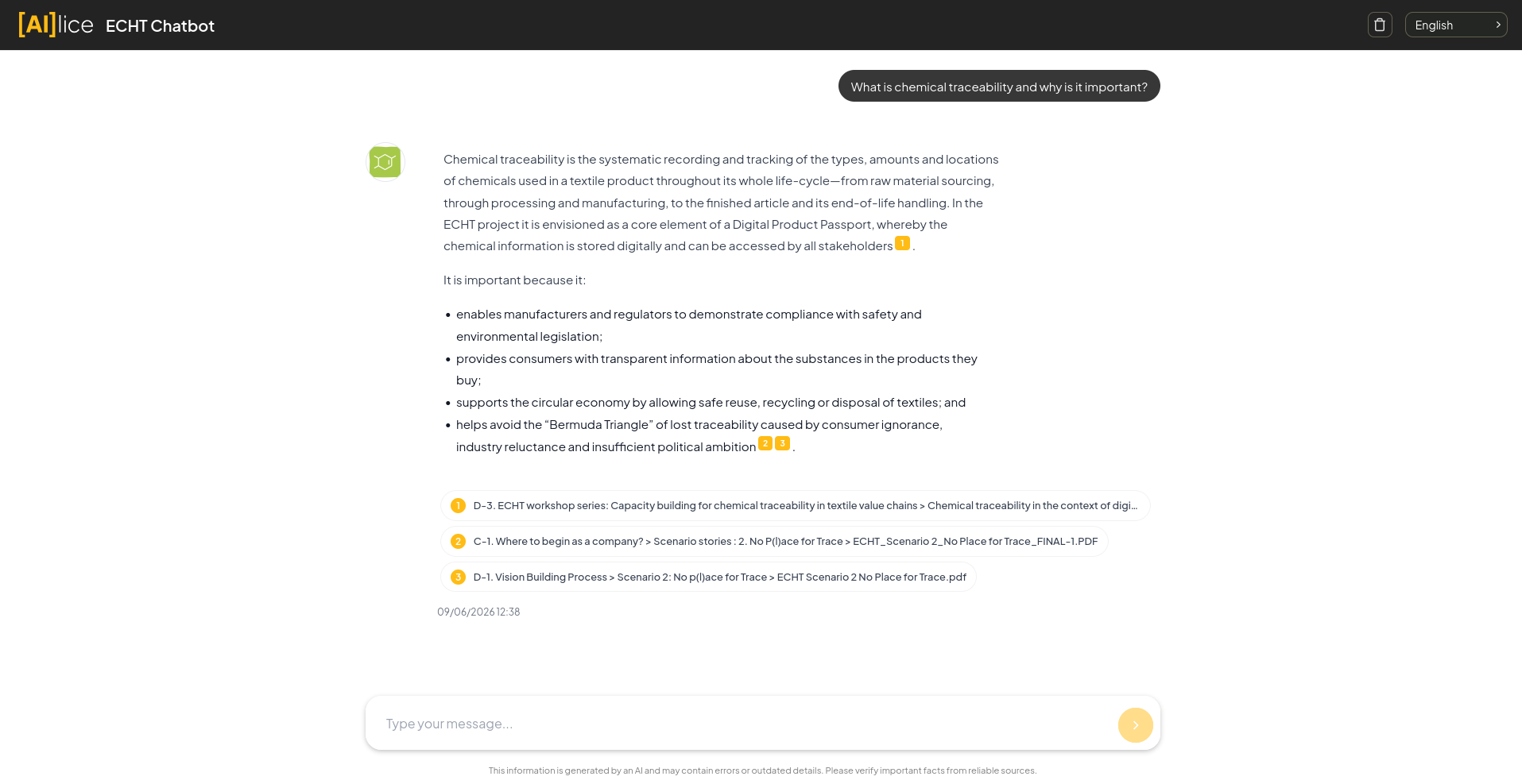
[AI]lice lets you create AI chatbots that are grounded in your course materials, not in the general knowledge of a language model. You upload your slides, readings, and handouts (PDF, Word, PowerPoint, and more), or sync directly from Moodle, and Alice builds a knowledge base from them. Every answer the chatbot gives is drawn from that knowledge base, with citations back to the source document.
Students get an answer and see exactly where it is coming from, and can preview the original material.
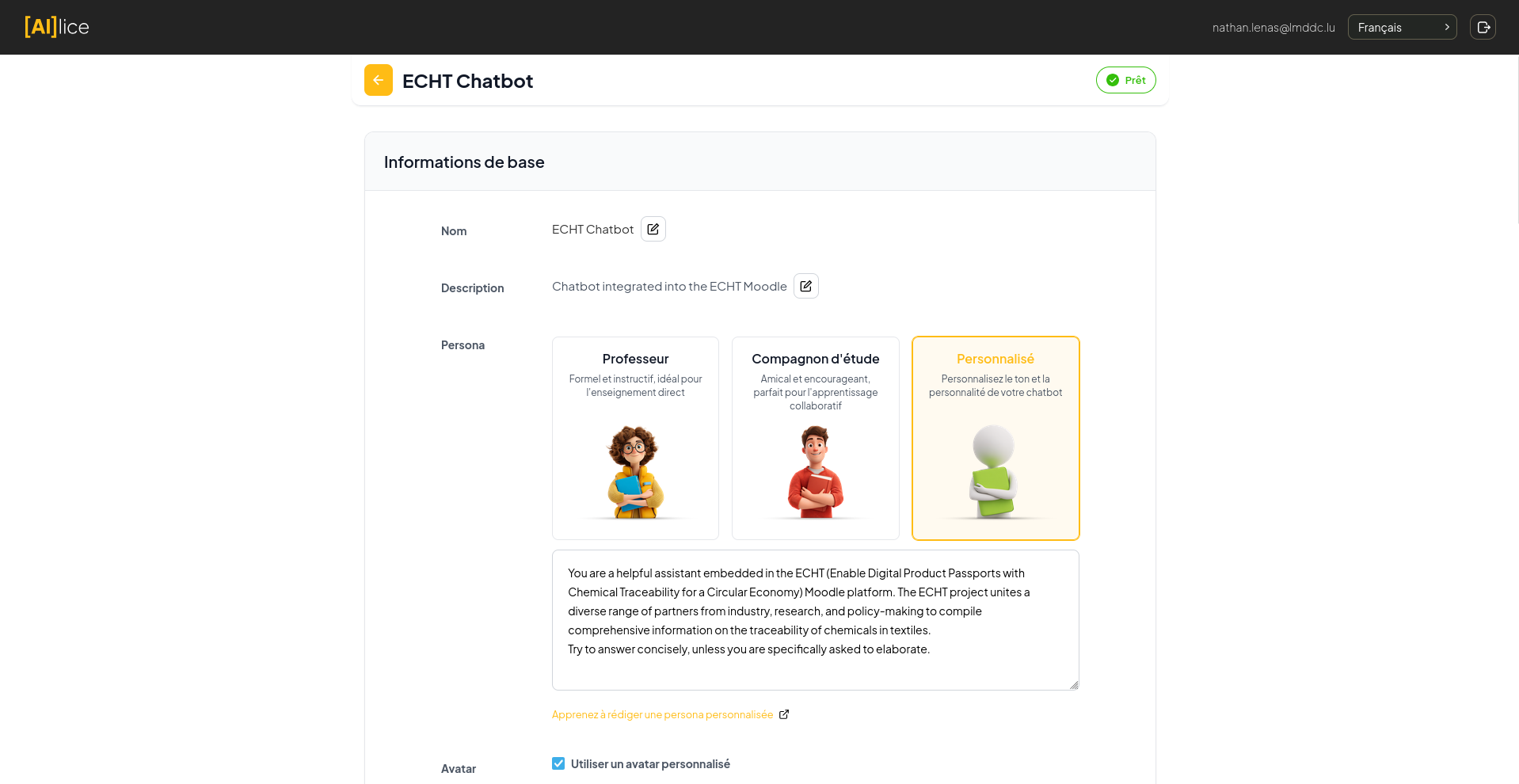
For educators, setup takes minutes. You log in, name your chatbot, choose a persona (a tutor, a conversational study buddy, or your own custom description), attach your materials, and share a link. That link can be public, password-protected, or restricted to users who authenticate through your institution's SSO.
Already used in projects
Alice is already in use beyond our own platform. Through ECHT, it serves as the knowledge platform helping textile industry professionals understand Digital Product Passport requirements and chemical traceability.
ECHT Interreg North-West Europe
Enable Digital Product Passports with Chemical Traceability for a Circular Economy
LMDDC collaborated with the Luxembourg Institute of Science and Technology (LIST) to develop the ECHT knowledge platform and its e-Learning modules. The platform helps SMEs in the textile industry understand chemical traceability and prepare for the Digital Product Passport, introduced as part of the EU Strategy for Sustainable and Circular Textiles. Alice was built to power it, and the funding from ECHT is what made Alice's development possible.
Partners: Hochschule Darmstadt (DE), LMDDC (LU), German Environment Agency (DE), Neovili (FR), ECRA (BE), H&M Group (SE), Team2 (FR), PUMA (DE)
Find out more at echt.nweurope.eu
Why we built it this way
The tools that already exist either require a technical team to run, lock you into a commercial platform, or give students access to a model that has no idea what's actually in your course. We wanted something educators could own, configure themselves, and trust.
That's why Alice runs entirely on open-source components, no dependency on a single cloud vendor, and why we've licensed it under the GNU AGPL. You can read the code, run it on your own servers, and modify it to fit your institution's needs.
Key features
Below is a table summarizing the main features:
Feature | Description |
Any format | PDF, DOCX, PPTX, plain text, and more |
Moodle synchronisation | Keep your chatbot up to date as your course evolves |
Citations | Every answer references its source document |
Access control and sharing | Public, password-protected, or SSO-only sharing |
Custom persona | Define the chatbot's tone, boundaries, and grounding policy |
OpenAI-compatible API | Embed Alice into your own tools and applications |
Who is it for ?
Alice is built for educators who want to offer students a reliable, course-specific AI assistant without handing over their materials and student's data to a third-party platform. If you can share a link, you can share a chatbot.
It's also designed with institutions in mind. Because Alice is self-hosted, your data stays on your infrastructure. Because it's open-source, your IT team can audit, adapt, and integrate it. And because every answer comes with citations, you can defend its use pedagogically: it's a tool that directs students back to the course, not away from it.
The team
Alice is a product of LMDDC :
Pierre de La Celle : Project manager. Led the project and designed the original RAG demo that kicked everything off at the first EdTech Speed Dating With AI workshop in October 2023.
Jessica Meldon : Design, Interface, and visual identity.
Nathan Lenas : Architecture, backend, and frontend.
Special mention to Kerstin Bongard-Blanchy and Claire Lombard, whose hands-on use of Alice within the ECHT project shaped the tool. Their feedback on real-world usage and the results they generated through ECHT were invaluable.
Get started
The best way to get a feel for Alice is to talk to it. We've set up a chatbot grounded in Alice's own documentation and this article, so you can ask it how installation works, how personas behave, or what the API does and see the interface, the grounded answers, and the citations exactly as your own students would.Try it here !
From there, it depends on who you are:
- Teaching in Luxembourg? Skip self-hosting entirely and create your own chatbot on our free hosted instance on skilltech.tools.
- Want to run it yourself? The full source is on GitHub at github.com/lmddc-lu/alice.skilltech.tools. The documentation covers installation, Moodle synchronisation, persona configuration, and the API.
- Have ideas or want to contribute? Get in touch with us! The project is still evolving, and contributions are welcome.

Nathan Lenas