

EdTech Track 2026: The Catch-Up Session

Mathilde Noël
4 minutes read |

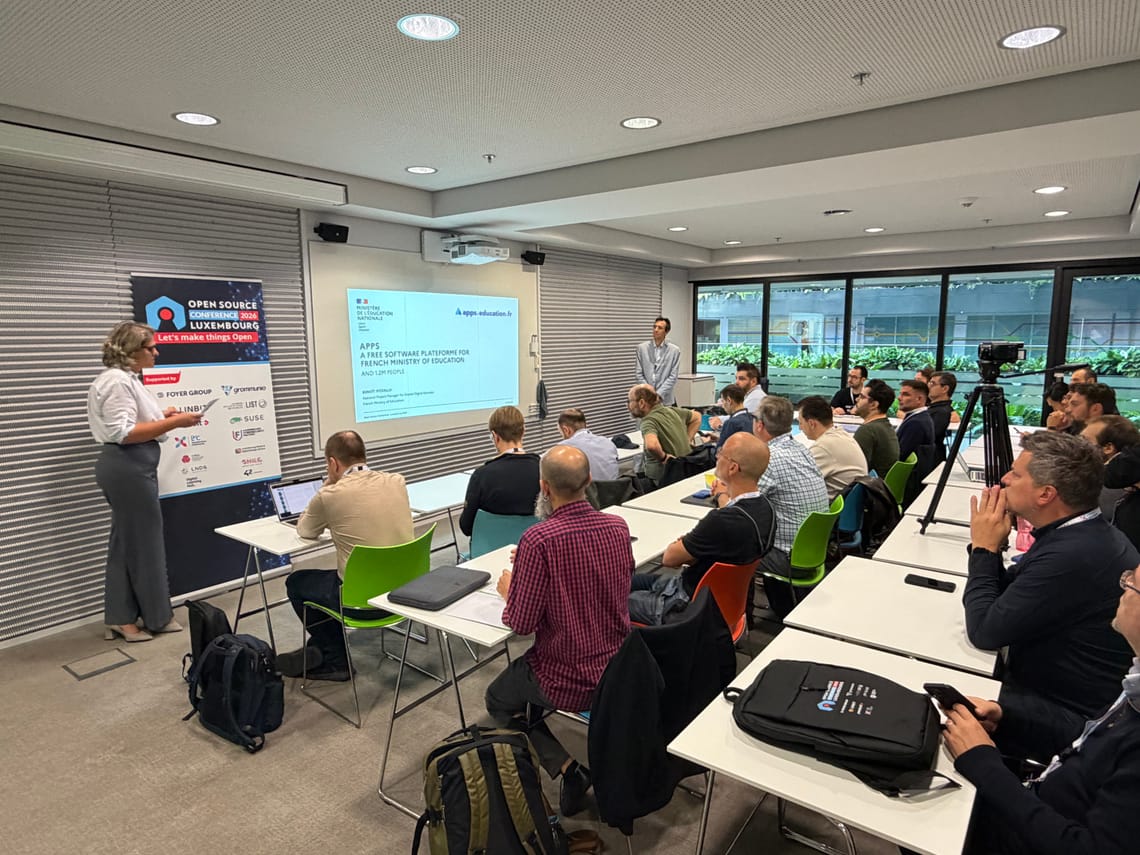
On 7 October 2026 in Belval, the Luxembourg Media & Digital Design Centre (LMDDC) hosted the EdTech Track of the Open Source Conference 2026. Eleven speakers from Luxembourg, France, Germany, Italy and the United States showed how open source is already transforming education and research: digital sovereignty, digital commons, interoperability, cybersecurity and artificial intelligence. Couldn't make it, or want to watch a talk again? All the talks are now available on video on skilltech.tube. Here they are, in running order.
#01 - Data That Travels: Cross-Domain Insights from Our Open Source Journey in Education
Education systems often rely on siloed edtech tools that deepen vendor lock-in and drive up costs. Opening the EdTech Track, Larry Kilroy (VP of Technology) presents the alternative developed by DataKind: an integrated open core software already adopted by more than 100 institutions serving over one million students. The goal: turning fragmented institutional data into a complete picture of each learner's success.
#02 - Apps: a free software platform for the French Ministry of Education
Since the 2020 lockdown, the French Ministry of Education has rolled out online collaborative tools for its staff on a massive scale. As head of the Apps.education.fr platform, Benoît Piédallu (Digital Project Manager, Directorate for Digital Education (DNE), French Ministry of Education) presents this suite of tools, built entirely on free software and now used by 1.2 million people. He discusses the choices made, how the administration contributes back to free software communities, and the benefits of this approach.
#03 - Building an Academic OSPO: Practical Governance Lessons for European Universities
How can a university manage open source professionally? Boris Baldassari (Eclipse Foundation, maintainer of the OSPO Alliance) shares practical lessons on setting up an Open Source Program Office (OSPO) in European universities. He draws on the experience of the OSPO Alliance, a coalition of European non-profit organisations, and on the Good Governance Handbook methodology.
#04 - Towards Digital Autonomy in South Tyrol – The FUSS Project Contribution
Launched in 2005, the FUSS project brought free software into South Tyrol's schools. It equips teachers and students with open source educational applications and builds lasting local expertise. Paolo Dongilli (FUSS Project Coordinator, Italian School Board of the Autonomous Province of Bozen-Bolzano) shows how, over twenty years, the project turned digital autonomy from a political goal into a concrete reality.
#05 - Building Digital Sovereignty in Public Education with an Open-Source IAM
SCHULE@BW proves that digital sovereignty at scale is possible for schools. Its digital workplace, based on openDesk, is used by 80,000 teachers across 2,700 schools in Baden-Württemberg, with Univention Nubus handling identity management and single sign-on. Ingo Steuwer (VP Platform & Technology, Univention) looks back on the 2025 migration from dPhoenix and the ongoing expansion of the platform.
#06 - One Million Teachers, One "Forge": How the French Ministry of Education is Building Digital Commons
How can a public administration strengthen its digital sovereignty by letting communities build and sustain shared resources? Sarra Hedhli (Product Owner for Digital Educational Commons, DNE, French Ministry of Education) presents the Forge des communs numériques éducatifs. She explains how projects born in classrooms become robust, lasting commons governed by their communities.
#07 - From Open Source Software to Public Digital Commons: Building a Sovereign Lifelong Learning Infrastructure
Through Digital FCU, FUN and 19 public universities are building a shared national offer of online professional training and micro-credentials. Emilien Sanchez (Head of Professional Training, France Université Numérique (FUN)) shares the lessons of this large-scale experience. His message: digital sovereignty does not come from free software alone, but from public institutions' ability to govern, operate and evolve their digital commons together.
#08 - French interoperability national framework: strategy and implementation
One of the French Ministry of Education's priorities is to support the education community with sustainable, interoperable and inclusive digital tools. Matthieu Guérin (Directorate for Digital Education (DNE), French Ministry of Education) presents the national reference framework under construction and the work underway to simplify the interoperability of digital education services using the OneRoster standard.
#09 - Open Source is Not New… At Least in Education and Research
Restena, Luxembourg's national research and education network, has relied on open source for 26 years. Cynthia Wagner (Chief Information Security Officer, Restena Foundation) traces this journey back to 2000 and discusses the impact of open source on data sovereignty and infrastructure resilience. Denim Latić (Security Analyst at the CSIRT, Restena Foundation) then reviews LuCySe4RE: a three-year effort to bring an open source security solution to Luxembourg's research and education community, from prototype to production service.
#10 - Leaving the hyperscalers without leaving the game: building our AI solutions with open source models
Can you build AI solutions without depending on the hyperscalers? Thibault Milan (Head of Digital, Paperjam) explains how Paperjam, one of Luxembourg's most influential media ecosystems, builds its AI tools on open source models. He shows how a preference for open ecosystems shapes the group's architecture choices in practice.
#11 - [AI]lice: A Sovereign, Customisable AI Chatbot for Safe and Contextualised Learning
To close the day, Nathan Lenas (Software Engineer, LMDDC) presents [AI]lice, the open source RAG application developed by LMDDC. AGPL-licensed, self-hosted and in production since December 2025, it lets any teacher create a chatbot based on their own course materials. The chatbot cites its sources and keeps no conversations by default. Nathan Lenas walks through the architecture, the real cost of self-hosting and the project's next steps.
Thank you to all the speakers, partners and attendees who made this EdTech Track a success, and see you next year!

Mathilde Noël
Mathilde is our Knowledge Dissemination Officer. She is passionate about communication, bringing creativity and fresh ideas to make knowledge accessible and engaging.