

Who teaches whom now? Takeaways from the second EdTech Café

Mathilde Noël
5 minutes read |

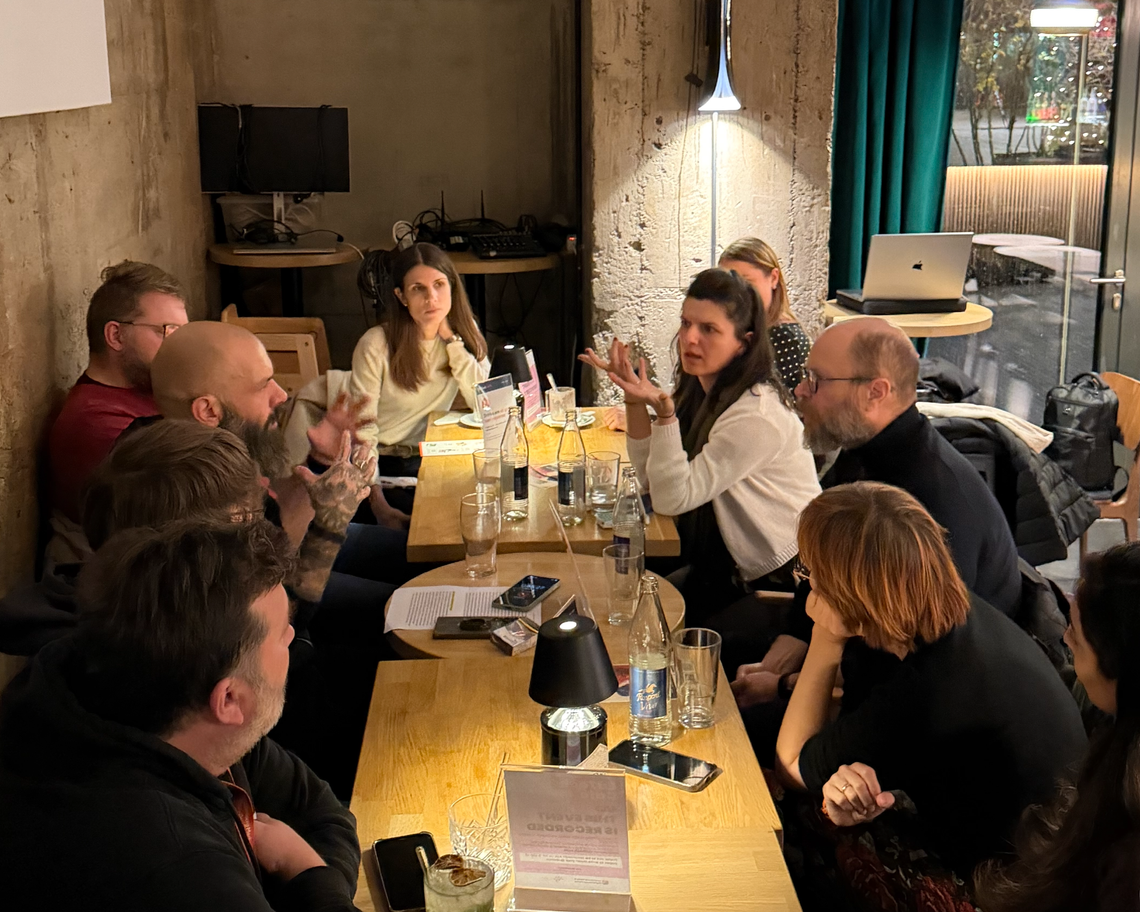
Teacher, learner, knowledge: for decades, this triangle has shaped the way we think about teaching. Now generative AI answers questions, explains and gives feedback. Does the triangle become a square, and who is teaching whom? That was the question at the second EdTech Café, held on Wednesday 18 November 2026 at Café SAGA in Belval.
The format stays the same: a table, a drink, a small group and no lecture. Our guest, Robert Reuter (University of Luxembourg), came to react, challenge and feed the discussion rather than give a talk. The conversation was moderated by Aurélien Savart (LMDDC).
Eleven people joined, Robert Reuter and Aurélien Savart included. Around the table sat teachers, researchers, a cognitive linguist just back from a language technology conference, a coding teacher who works with kindergarten children, and curious newcomers. Here is what came out of an hour and a half of debate.
A triangle, or already a square?
The evening opened with a question of shape. Should schools be added to the triangle, since they set policy and support teachers? Many felt the teacher's role is shifting towards that of an AI literacy facilitator. Yet most teachers have no training in computing, and spotting the biases built into language models is hard. Who trains them, who pays for it, and who makes it happen?
The frame was then widened. The pedagogical triangle only really makes sense inside school. Out in the world, we learn without a teacher: drop a bottle and you find out something about gravity. School is the institution that made us take the teacher's place for granted.
The table then turned to an idea floated by Demis Hassabis: let AI deliver content at home and turn teachers into Montessori-style guides. The idea met strong pushback. Guides towards what, if teachers are not trained themselves? And who teaches a child to question a chatbot? Families who can afford better tools, and parents who understand them, would pull further ahead. The gap would widen rather than close.
Knowledge doesn't fall from the sky
The conversation then moved to mediation. School has always told a certain story: in France, the history taught in class carried the values of the Republic. Today's AI tools are mostly built in the United States, and they see the world through that lens.
Research backs this up: a large share of the errors these models make comes from English interference. Trained mostly on English, they push a single cultural view, and users rarely notice. Some researchers, such as bilingualism specialist Antonella Sorace, even warn that low-resource and heritage languages could be pushed towards extinction.
Humans are biased too, the table agreed: Europe's memory of the Second World War owes a lot to Hollywood. History makes the lesson obvious: knowledge never falls from the sky. The historian's question, "how do we know this is true?", deserves a place in every subject, biology included. AI simply makes that question impossible to ignore.
What it means to learn when the machine does the work
AI does not disrupt access to knowledge: the web and Wikipedia already did that. What it changes is what it means to learn. With one click, you can look competent at something you never practised.
One image summed it up: if you are training for a marathon, you have to run. If your only goal is to end up 42 kilometres away, take the car.
That leads straight to assessment. A well-argued essay used to count as proof that someone had done the thinking. That proof no longer holds, and exams without any resources hardly prepare people for a world where everyone uses these tools. Universities are not spared: their legitimacy rests largely on the diplomas they award, and other learning spaces are emerging. Self-study is nothing new either: some passed exams long ago by working alone from a professor's book.
Students are not stupid. They quickly learn that their job is to deliver an answer as fast as possible, with as little effort as possible. Parents, the dictionary, the web, now a chatbot: school becomes a game, and they play it. And the tools are already there: according to a recent study mentioned at the table, 91% of 16-year-olds had used generative AI in the past month. Whatever tools schools choose, the kids already have them in their pockets.
The teacher, however, is more than a content provider. A teacher builds a relationship and answers the question "why should I care?". The robot, after all, doesn't care. Some objected that this describes an ideal teacher. Others warned that oral exams, often proposed as the fix, put dyslexic or ADHD students at a disadvantage.
Teaching AI the way we teach children
The debate then took a deliberately provocative turn. Professional AI users now write "skills": instructions that capture the essence of how a task is done. Asking a child to write about their weekend works the same way. What matters is not the weekend, but learning to sort ideas and put them in order. Reinforcement learning, too, is reward and punishment, much as we raise children. So are we already teaching machines what we should be teaching kids?
Not everyone was convinced. In a language model, words point only to other words. When humans use a word, it comes with images, sensations, a memory of patting a pet. Models produce effects of meaning, not meaning itself. The question was even debated when the EU AI Act was drafted: can a machine be said to "understand"?
The table did not settle it. Our brains also run on prediction, and fiction lets us grasp lives we never lived. Rousseau learned to reason by watching others reason; Picasso recombined what earlier painters had done. One point did win agreement: learning is embodied. Today's debates focus on cognitive friction, but children also learn through social and physical friction.
Code, juniors and resilience
Coding came up as a test case. Many companies now skip juniors: why hire someone who will ask the chatbot when you can ask it yourself? The view from a peer-to-peer coding school such as 42 Luxembourg shows the flip side. Learners who rush through projects with ChatGPT, afraid of falling behind, never build the skills the programme is there to teach. The new skill is knowing the pitfalls, asking the right questions and overseeing a whole project.
After all, no company sells code. Companies sell features people use. Value now lies in the extra mile a human adds: thinking outside the box and knowing why one choice beats another.
The question of resilience followed. Almost none of us could survive as hunter-gatherers, yet those were humanity's core skills for most of its history. As long as the system works, we feel in charge. But what if Microsoft crashes on a Friday morning? The answer from the table: relying on technology is a collective choice, and one we have to own.
The most striking example came from kindergarten. Children aged four to six, who cannot yet read or write, program small robots with Scratch Junior. Nobody explains electricity to them. They learn that if you put this block here, the robot goes up. Logical reasoning, before written language.
What we take away
The triangle did not become a square that evening, but the debate showed where it is under strain:
- Teachers first: if AI is in every pocket, the priority is training and supporting teachers, not buying more tools.
- AI literacy, beyond the tools: knowing how to prompt is not enough; it means spotting biases, stereotypes and cultural blind spots. Others would rather speak of lasting skills: critical thinking, communication, creativity, empathy.
- Learning, not looking competent: when a machine can produce the answer, the effort is the point, and assessment has to follow.
- How do we know?: the method behind knowledge matters more than ever.
- Reasoning early: logic can be learned before reading and writing, and it carries over to everything else.
One question hung over the whole evening. Perhaps AI is simply confronting us with an education system built for the industrial age, and asking us what we expect from learning today.
Thank you to Robert Reuter and to everyone who joined us at Café SAGA. EdTech Café is a joint initiative of the LMDDC and SCRIPT.
Mathilde Noël
Mathilde is our Knowledge Dissemination Officer. She is passionate about communication, bringing creativity and fresh ideas to make knowledge accessible and engaging.