

EdTech Café #01 - What's left to learn when machines write?

Mathilde Noël
6 minutes read |

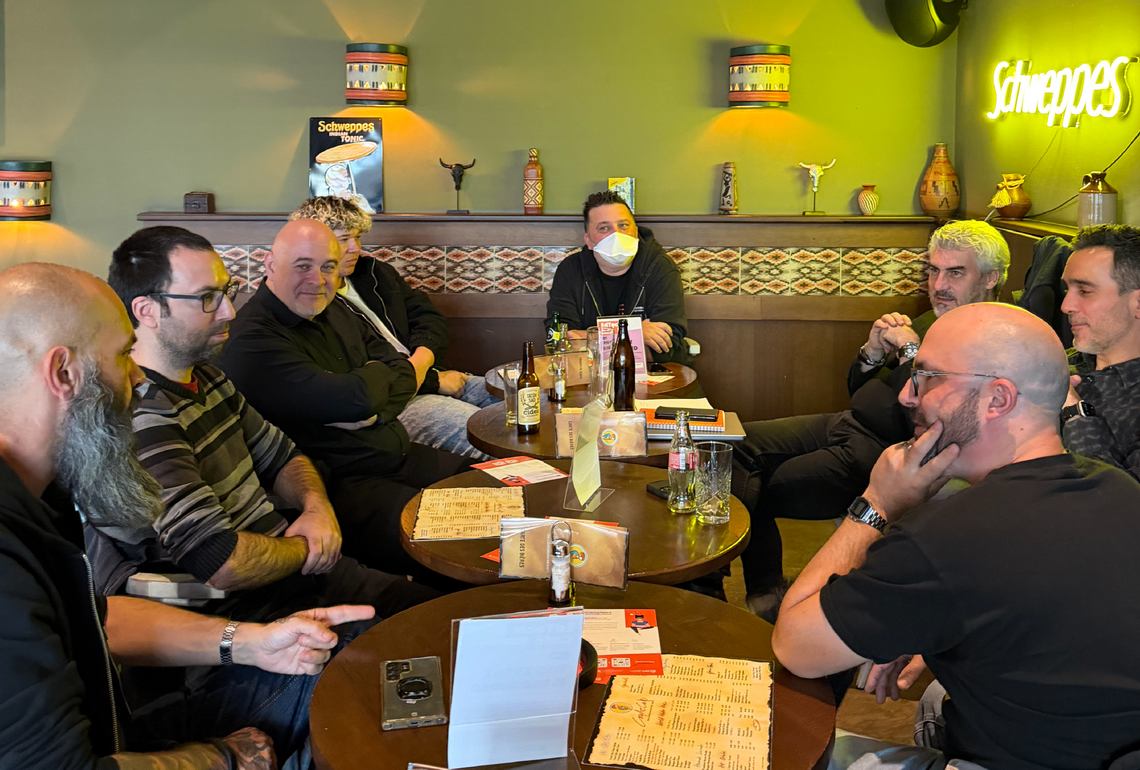
If machines can produce the text, what is still worth learning? That was the question at the very first EdTech Café, held on 14 October 2026 at Café Coyote in Belval.
The format borrows from the philosophy café: a table, a drink, a small group and no lecture. Our guest, Marco D'Amico, is deputy director of the Digital Learning Hub in Belval, which runs hundreds of continuing-education courses a year, the 42 Luxembourg coding school and academies in AI, cybersecurity and quantum. His role: to react, challenge and feed the discussion rather than deliver ready-made answers. The conversation was moderated by Thibaud Latour, director of the LMDDC.
The theme: how to combine fundamental knowledge, digital literacy and artificial intelligence to enrich learning. Around the table sat developers, a student, trainers and curious newcomers. Here is what came out of an hour and a half of debate.
Is AI just a better calculator?
The evening opened on a familiar comparison. When the internet arrived, people feared students would no longer know how to search a library. They didn't need to, and the time saved went elsewhere. Several participants saw AI the same way: a tool, provided it is used properly and its answers aren't taken as gospel, any more than a Wikipedia article.
Thibaud pushed the analogy further. When a calculator shows 2 + 2 = 4, nobody checks. Will we one day trust AI the same way? One developer thought so: we check today because the technology is new, but after the hundredth correct answer, we stop checking the hundred-and-first.
Marco's objection came quickly: who signs off on the result? If code you didn't write miscalculates a bank's interest, the responsibility is still yours. On that point the whole table agreed: you can delegate the task, never the responsibility.
No critical thinking without foundations
Everyone agrees that critical thinking is essential. But Marco raised the question that ran through the whole evening: how do you judge an answer on a subject you haven't mastered? And how do you build that mastery if you skip the ordeal of the blank page?
His image stuck: asking AI to think for you is like sending your neighbour to the gym in your place. The weights get lifted, but you're not the one who gets fit. If the goal is learning, the effort is part of the journey.
That doesn't mean never delegating. Participants drew a line between core skills and secondary ones. A founder can hand the code to AI if their real work is the concept; a developer can hand it the illustrations. The risk lies in using AI for things you could neither do nor check yourself: trusting it then becomes, as one participant put it, Russian roulette.
From content to reasoning
From the library to Wikipedia, technology gave us ever easier access to content, but reasoning stayed human. Chatbots change that: they hold the content and they reason too. Raw knowledge matters less; the ability to process it, metacognition, matters more.
The idea put forward at the table: rather than replacing our thinking, AI might push us to sharpen it. If a machine can reason, we have to become even more attentive and critical. Teaching would then shift from delivering content to practising how to work with it, with AI as a sparring partner. It is no longer we who challenge AI, but AI that challenges us.
This is the whole difference between artificial and augmented intelligence. The engine remains human cognition; AI multiplies its reach. The open question is how deeply we need to understand the technology: few people who use neural networks could write out their equations, yet they understand how they work and what they are for. That level of abstraction may be what schools should aim for.
Curiosity makes the difference
A language teacher recently told one participant that there is no longer any need to learn grammar, since AI writes perfect letters. He disagrees. As a non-native French speaker, he drafts his letters himself, asks AI for a more formal version, then checks it still says what he meant. Along the way, he picks up turns of phrase he would never have found alone. Someone who asks "write me a letter" and sends it unread learns nothing. Same tool, opposite outcomes.
After content, reasoning and metacognition, a fourth dimension emerged: attitude. Some use AI to learn more, and the more they learn, the more curious they become. Others let the machine do everything. Several participants feared AI would widen that gap rather than create it, since curiosity is often lost long before, when a child's questions go unanswered.
The examples shared were encouraging, though: a student who learned a new programming language by coding his own game with AI, and a younger brother, not at all into tech, who took apart and repaired his games console with AI guiding him. For curious minds, AI can be an accelerator, whether the subject is code or an engine. Memorisation sparked debate too: should children still learn poems by heart to train the brain, and which kinds of memory still matter in 2026? Montessori-style pedagogy, built on curiosity and experimentation, was mentioned as a possible path.
Tutors that hold back the answer
Can technology fix the problems it creates? Marco quoted the philosopher Günther Anders, then gave a concrete example. At 42 Luxembourg, a programme run by Digital Learning Hub, the curriculum has been redesigned around AI. Students build and refine their own assistant throughout their studies, designed as "slow AI": it doesn't give the answer, it guides and creates the friction needed to learn. And because this model is their "baby", it motivates them too.
A study mentioned during the discussion points the same way. In a high-school maths experiment, students given a generic chatbot did better on the exercises, but once the tool was taken away, they scored 17% lower than those who never had it. Students given a tutor designed to guide rather than answer progressed even further, without suffering that drop. The tool matters as much as the use.
Another strength is personalisation. A teacher facing 30 pupils can't adapt 30 times; an AI tutor can. But that requires building real pedagogical skill into it. Hence a powerful idea from Thibaud: the answer may lie in crossed literacies, the skills we give AI in order to develop the ones we want to see grow in humans.
A political literacy
Toward the end of the evening, the discussion widened. We are told we must master AI in an operational sense: use it, prompt it, solve problems with it. Thibaud proposed another kind of mastery, in the political sense: keeping control of it. Only a handful of organisations can train these models and decide what goes into them. Understanding those stakes could be a literacy in its own right.
Participants drew the link with smartphones: many young people, and adults, don't know what a file is or where their data lives, and are helpless at the slightest problem. Abstraction makes technology accessible to more people, but it also makes them more dependent.
Should it become a school subject? Marco pointed out that courses on AI fundamentals, risks and ethics already exist, such as the 30-hour Elements of AI. He sees it as an extra pillar alongside maths and languages. But a course doesn't settle the deeper question: how do you make people want to learn when an answer is three seconds away? Language emerged as a possible path: a prompt is an instruction given in words, and it is in language that concepts take shape.
A student's view
The last word went to the youngest at the table, and it was clear-eyed. A computer science student, he admitted he is no longer sure he wants to work in the field. He had planned to become a front-end developer and doubts the job will still exist in five years. Around him, he said, many aim mainly for certifications to prove their expertise to employers.
Marco had raised the same issue from the employer side: companies now hire experts rather than juniors. How do you become a senior without ever being a junior? Yet the student sees new profiles emerging, such as creative developers able to orchestrate AI tools. And the table agreed on one point: we should listen more to young people about what they need.
What we take away
No one left with a final answer, and that was the point. But the evening drew a clear map of the literacies at stake:
- Content: a base of knowledge is still needed, if only to judge what AI produces.
- Reasoning and metacognition: knowing how you think matters more than what you memorise.
- Attitude: curiosity turns AI into a learning accelerator rather than a shortcut.
- Political literacy: understanding who builds these tools and what is at stake in using them.
- Responsibility: you can delegate the task, never the responsibility.
Thank you to Marco D'Amico and to everyone who joined us at Café Coyote. EdTech Café is a joint initiative of the LMDDC and SCRIPT.
Next EdTech Café: 18 November 2026 at 5pm, Café SAGA, with Bob Reuter (University of Luxembourg), on "The pedagogical triangle put to the test of AI". Ten seats, no booking: first come, first served!

Mathilde Noël
Mathilde is our Knowledge Dissemination Officer. She is passionate about communication, bringing creativity and fresh ideas to make knowledge accessible and engaging.