

Learning impact Europe 2026: Rethinking Assessment, Interoperability and AI

Nathan Lenas, Györgyi "Gira" Szakmár, Michalis Spyropoulos
6 minutes read |


Thessaloniki turned out to be the perfect place for this year's 1EdTech Learning Impact Europe. It is a vibrant university city where the far past and the future hold hands, wrapped in warm water and golden sand. Our hosts at the Aristotle University of Thessaloniki made it feel easy from the first minute, which matters more than people admit at conferences. AUTh, Greece's largest university and a pioneer in digital transformation, was the first university in the world to sign the 1EdTech Trusted Apps pledge, so there was something fitting about gathering there to talk about trust, standards and what we owe to learners. We were there representing LMDDC, with a networking game and two sessions on sovereign AI learning assistants and on building an open source EdTech toolbox.
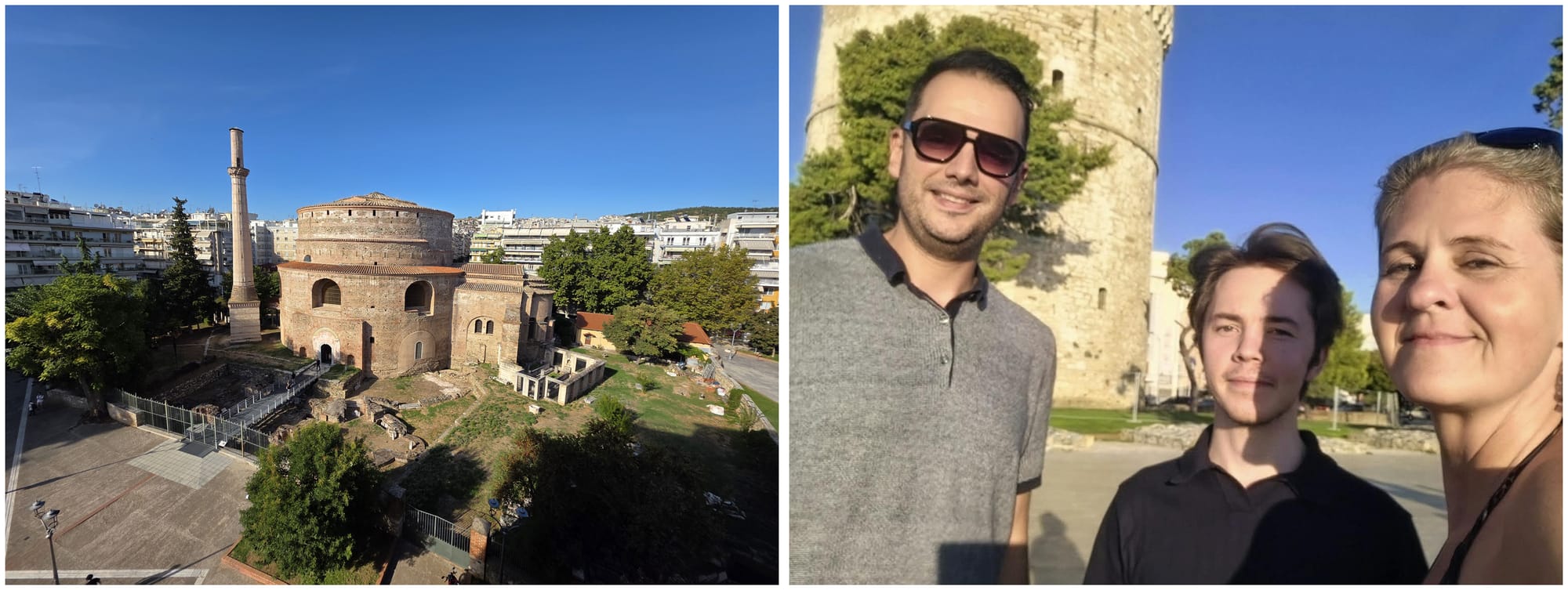
We work on open source and interoperability related projects all year around, but it's easy to get stuck in our own bubble. At the 1EdTech conference, it was reassuring to see people navigating the same challenges, and to see their solutions and ideas.
Interoperability is a cultural problem, not only a technical one
The first highlight for us was the Understanding and explaining interoperability presentation. Their starting point was that interoperability isn't only a technical problem, it's a cultural one, and communicating it cannot be only done through architecture diagrams.
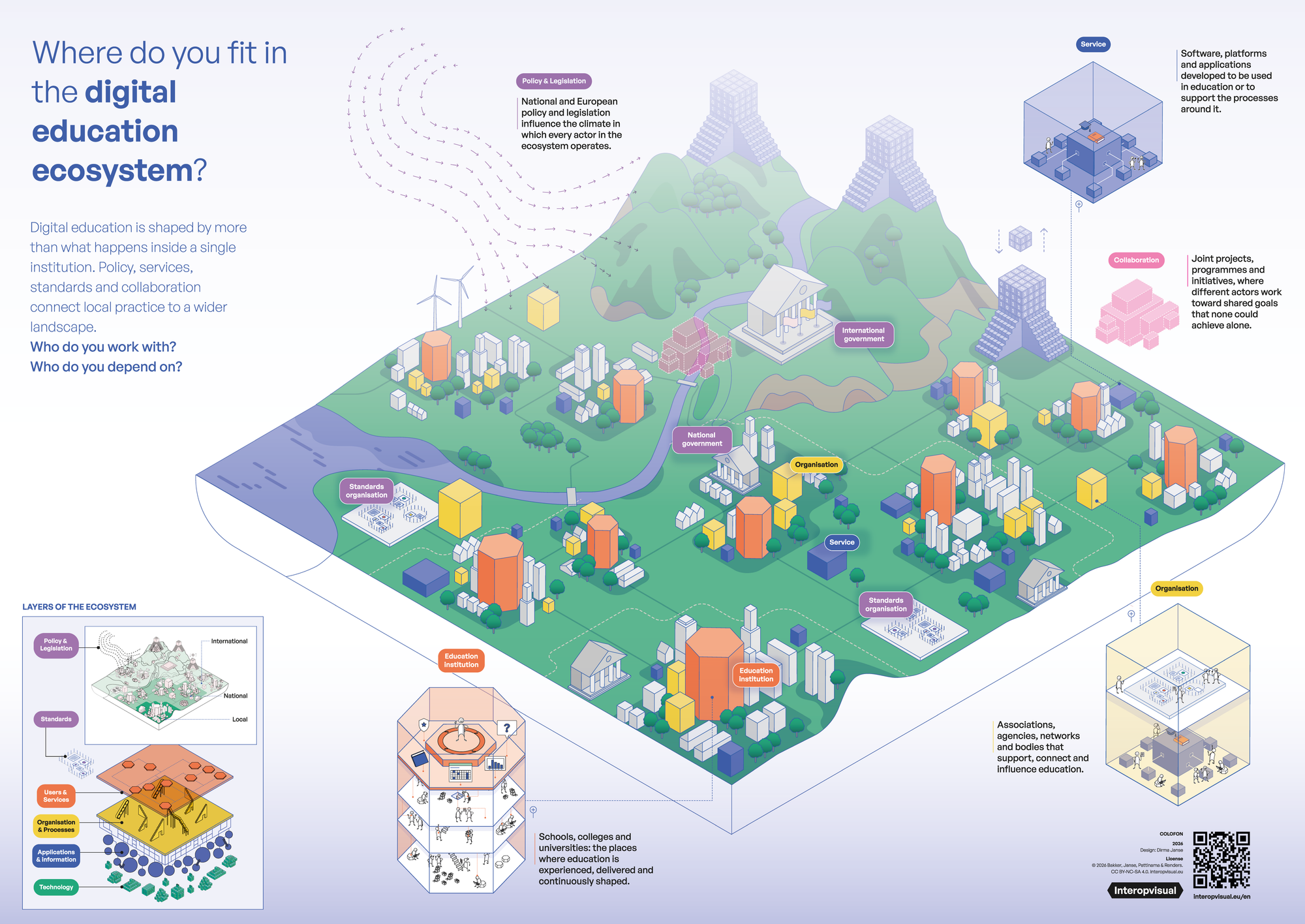
Interopvisual's "digital education ecosystem" illustration renders the whole landscape as an isometric map: a base layer of Technology and Applications & Information rising through Organisation & Processes and Users & Services, up to Standards and Policy & Legislation at the summit. Scattered across it are the actors who populate that landscape.
Uniformity or diversity: the two sides of interoperability
Another nice way to frame why interoperability matters came from "Shortening the Distance to Interoperability."presented by Fransesc Santanach-Delisau, Jeff Merriman, and Joshua McGhee. They frame it as such: interoperability has two sides: the dark side is increasing uniformity, and the light side is improving diversity. Increasing uniformity is the easy path, it does improve the interoperability but it flattens everyone into the same mould. The "light" side is the harder path: Improving interoperability by improving diversity, and developing standards so that very different institutions can keep their own data models and keep exchanging data with others.
At LMDDC, this is the trade-off we navigate when we adopt standards like LTI and QTI. The goal isn't to make every LMS or authoring tool look the same, it's to make sure a tool built for one context doesn't stay trapped there. The same question shapes how we select tools for skilltech.tools: a tool that only works in isolation, however good, adds another silo rather than strengthening the ecosystem.
Giving AI the right context: the trusted portable learning context
As we are working often on AI projects for educational purposes, we were impressed and got a glimpse of what the future of AI in education could look like with 1EdTech's work on a portable learning context for AI, presented by Chief Architect Tim Couper.
The premise is simple: when an AI assistant gives a poor answer, it's often not the model failing, it's missing context, such as the learner's progress, the objectives, the course constraints. 1EdTech's answer is the trusted portable learning context, or tplc: a structured, time-bound description of one learning situation. It builds on top of the vocabulary that 1EdTech maintains (QTI, CASE, Caliper and OpenBadges) and on open web foundations like Verifiable Credentials.
Assessment in the age of AI
Assessment is one of the fields most unsettled by AI right now, and several sessions tackled it from different angles: On what we test for, Louise Plunkett from D2L made the case for rethinking what we actually test for, toward models that make a learner's thinking visible during the assessment process, rather than just the final answer.
On the standards side, 1EdTech Technical Standards Architect Julien Sébire, argued for a simpler, AI-ready profile of QTI 3, since complexity has been a barrier to institutions adopting it.
Closer to home, Luxembourg-based Miguel Prieto, VP of Corporate Strategy at Open Assessment Technologies, addressed a practical problem: generating assessment items with AI is easy, but generating good ones is hard. Working with the Luxembourg Institute of Science and Technology (LIST), OAT built an LLM-as-judge validator that flags hallucinations, incorrect answer keys, weak distractors, bias and accessibility barriers.
Our sessions: sovereign AI and an open-source toolbox
As for our own contributions, we had two sessions. The first, "Designing Safe, Content-grounded, Sovereign AI Learning Assistants," presented [AI]lice, the tool we built at LMDDC so educators can create chatbots grounded in their own course material. The idea is that teachers stay in control of three things: the content the assistant draws on, the data it handles, and how it behaves, through instructions and personas they write themselves. Answers come with citations back to the source material, personal data is filtered out, and conversations aren't stored by default. Since June, [AI]lice has been open source and self-hostable, and it also connects directly to Moodle, keeping its knowledge in sync with the course.
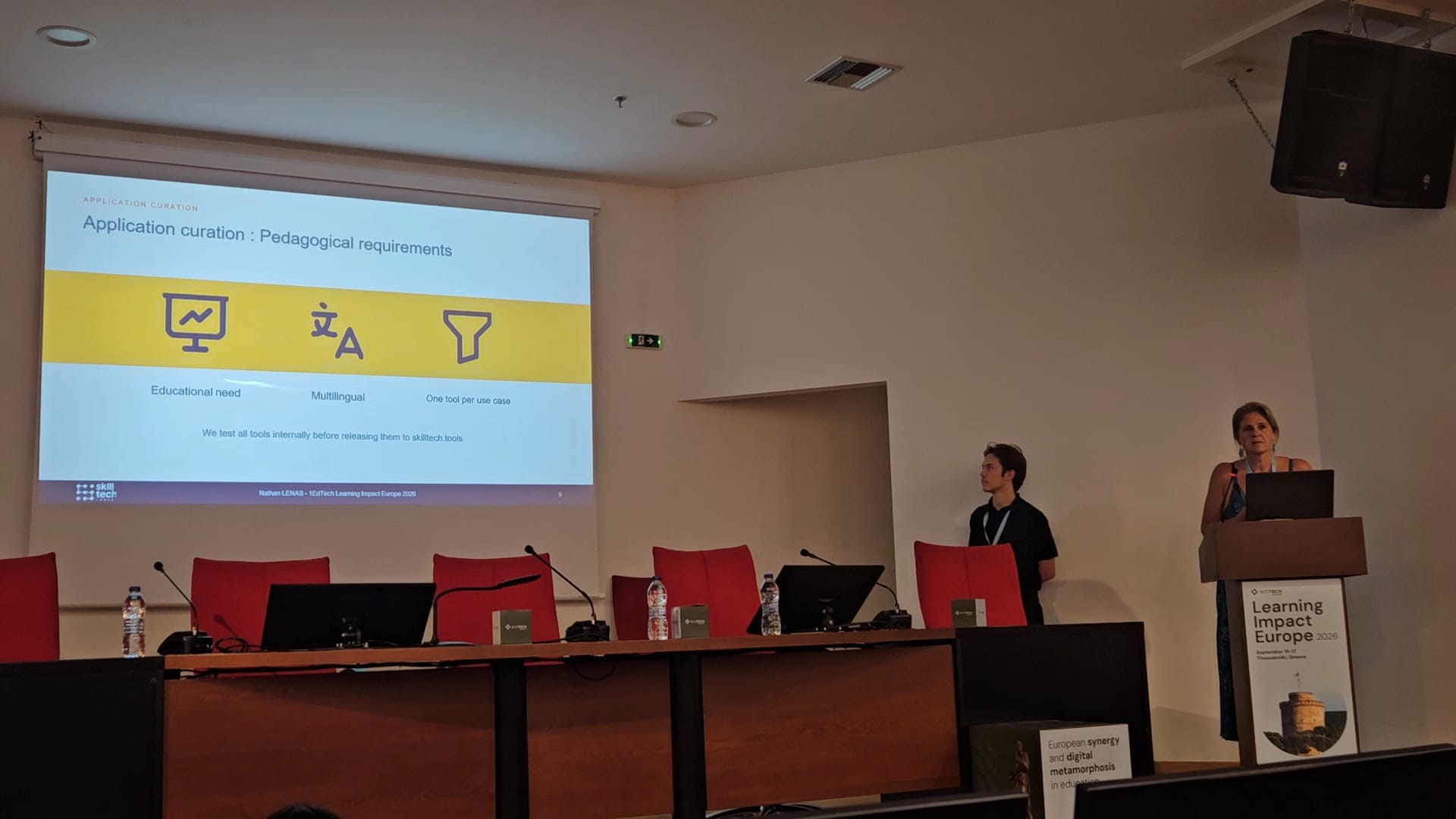
The next day, "Building a Sovereign EdTech Toolbox: Open-source Alternatives". We showed how skilltech.tools, a curated suite of open-source tools offered free of charge to Luxembourg's educational community, is designed, deployed and run on national infrastructure. Every tool we add has to be open source, actively maintained and built on open standards, and each one is tested internally before release. The broader point was that public institutions can reduce their reliance on commercial platforms without giving up usability, while keeping data sovereignty, cost efficiency and interoperability in their own hands.
The Handshake Hunt: gamifying networking
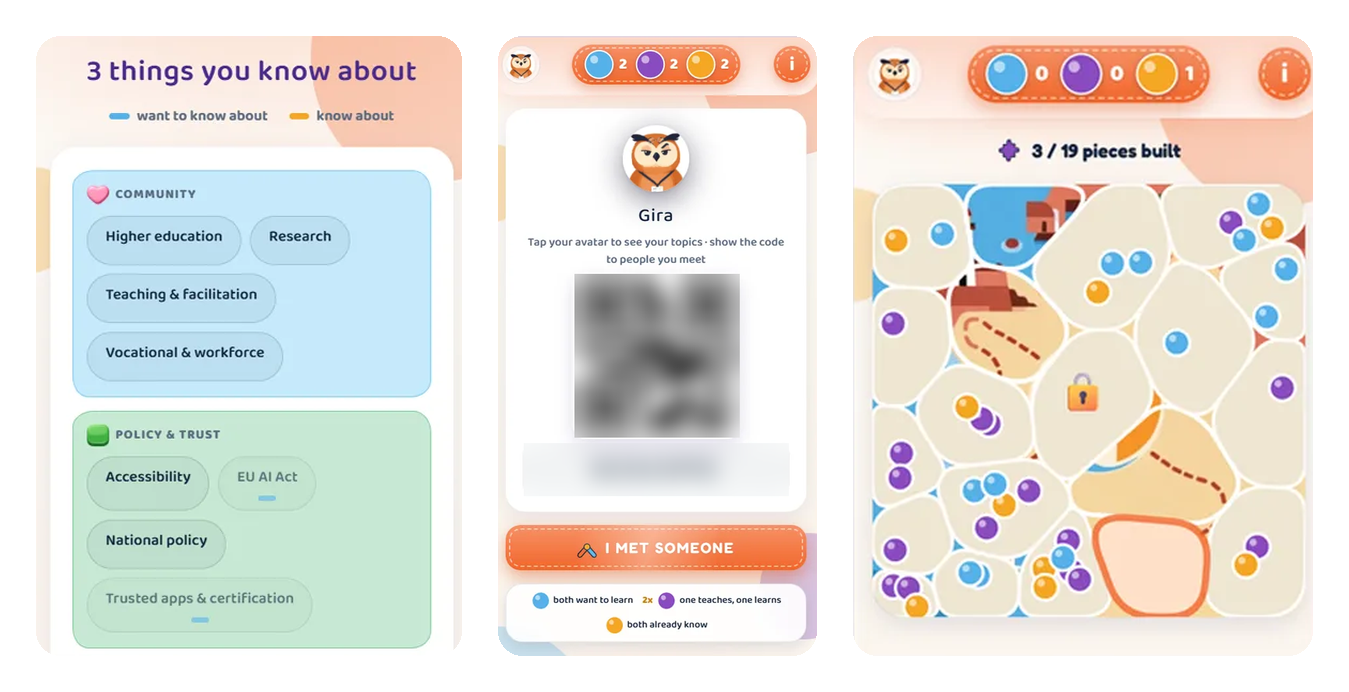
Conferences are also about the conversations in between sessions, so we brought something a little more playful to Thessaloniki: the Handshake Hunt, a networking game we built for the event. Participants started by entering the areas of EdTech they know and the ones they wanted to learn more about. Each player had their own QR code, and when two people met, scanning each other's code started a conversation, with icebreaker questions suggested for them to start talking. Every new connection earned points, and players spent those points to unlock the pieces of a puzzle. Anyone who unlocked every piece won a small treat. It was a simple way to get people talking who otherwise might never have the occasion to meet, and the idea was to turn "who should I talk to?" into "what can we learn from each other?"
Conclusion
We participated of several Learning Impact Europe events now, and the rhythm used to be familiar: what is new, what has been done, what still needs doing. What is happening in EdTech, if that standards and interoperability match reality. This year felt different. There were a lot more question marks in the room. How do we move AI in a more ethical direction. How do we assess at all in the age of AI. How do we even talk about interoperability so that the people who have to fund it and use it understand what we mean. Add to that credentials and wallets, digital sovereignty, security, quality assurance. We might not know all the answers yet. What we keep taking home from this community is that so many brilliant brains are seriously looking for them, together.
Ps.: Big news! 1EdTech Europe became an independent legal entity in May, a new chapter that Gill Ferrell and Curtiss Barnes and the whole organising team carried through the week with a lot of care. The inaugural General Assembly of 1EdTech Europe took place on the last day. Acting as the governing body for 1EdTech's European members, 1EdTech Europe is an independent organisation with a mandate to pursue its own priorities, chief among them, shaping open standards that align with European regulations. As a member of the Alliance, the LMDDC was invited to cast a vote for electing the Advisory Board.

Nathan Lenas

Györgyi "Gira" Szakmár
Györgyi "Gira" Szakmár is our Multimedia Design Manager. She is passionate about game-based learning and an expert in gamification.

Michalis Spyropoulos
Michalis heads up knowledge management, business development, and communication.